Which AION 2 class fits how you play?
Choose a responsibility before choosing a ranking. The comparison tool separates frontline engagement, protection, recovery, stealth, ranged shots and magic so that you can ask a concrete question: which job would I still enjoy after the first hour? These are filters for a shortlist, not restrictions on what a class can accomplish.
Make the first comparison small
Select two classes with one meaningful difference, such as Templar and Gladiator or Chanter and Cleric. Read their identity notes together, then identify what you would test. Adding a third candidate can reveal a different approach; selecting everything usually hides the decision you are trying to make.
All eight Global classes explained
Gladiator: stay engaged at the front
The Global introduction presents Gladiator as a frontline blade fighter. Start here if being close to the encounter is part of the appeal. In a trial, notice whether you can maintain useful contact without following an enemy into danger. A dramatic weapon is an identity cue, not evidence of the highest damage. Compare this preference with the more explicitly protective Templar before committing to a main.
Templar: make protection your responsibility
Templar is introduced through its shield and protective front-line role. That makes it a sensible candidate when protecting the group is the task you want to own. Test whether you enjoy communicating positioning and watching allies as well as the opponent. The official identity alone does not establish a universal tank build, required defensive stat or guaranteed place in every party.
Assassin: decide how to approach
Assassin centers on an unseen approach and a stealth identity. Ask whether you enjoy creating an opening rather than simply attacking the nearest target. During a trial, separate the attraction of an initial strike from the responsibility of choosing a safe exit. This is a playstyle comparison; it does not promise a particular stealth duration, escape skill or competitive burst ranking.
Ranger: work with distance and timing
The official Ranger description emphasizes ranged shots. Consider this class when keeping a useful line of attack sounds more appealing than constant close engagement. Your practical trial should include movement, obstructed lines and target changes. Range does not automatically mean safety or easy play. We have not measured its reach against other classes or ranked its effectiveness across every encounter.
Chanter: think about the group
Chanter is described around blessings and protection. Choose it as a candidate if supporting the party is an active responsibility you enjoy. In a trial, ask whether tracking allies and deciding when to contribute protection feels satisfying. Do not infer a complete healing kit from the word support. Compare the current skill panel with Cleric when recovery is your main priority.
Cleric: prioritize recovery
Cleric is the clearest recovery-centered identity in the official introduction. Consider whether reading the party situation and anticipating a recovery need appeals to you. A trial should include situations where several things demand attention at once, rather than only a stationary target. We do not convert this role description into a healing-per-second score, solo ranking or claim that every group requires an identical setup.
Sorcerer: build around spellcasting
Sorcerer offers an offensive arcane identity. It is a useful starting candidate when the fantasy of spellcasting matters more than a weapon-focused approach. In a trial, observe how positioning and interruptions affect your experience. The class introduction is not a complete spell list: cast times, control effects and numerical costs must come from the applicable client rather than assumptions about similar games.
Spiritmaster: choose the spirit-commanding identity
Spiritmaster is distinguished by spirits and elemental power. Consider it if that relationship is central to how you want to play. A useful trial asks how comfortable you feel managing the encounter while maintaining your own position. The official introduction does not establish every spirit command, automated behavior or summon limit. Read those details in your current client before building a rotation.
How this class comparison uses evidence
The roster and short identities come from the official Global About page . We independently paraphrase those identities and label our decision questions as editorial guidance. The source supports eight Global classes; it does not provide a measured difficulty scale, complete weapon inventory or controlled PvE and PvP results.
Keep region and patch together
A new class or skill adjustment announced for Korea or Taiwan does not automatically establish its availability in Global. Check your region before copying a class list. Our November 6 source review is an editorial check, not a claim that we played every class or tested the current combat balance.
From a class choice to a skill plan
Open the AION 2 Skill Builder for your shortlisted class. Read the budget, available slots and selected skill costs from the same client version. Record whether a point figure is a total investment or the price of one additional rank. A saved plan is useful only when its assumptions remain recognizable.
Use a repeatable trial
Give both candidates the same task and note movement, target selection, group responsibility and the controls you actually use. An enjoyable short trial is stronger personal evidence than an unexplained letter grade. Our event and reset timers can help schedule another session, but do not establish a class advantage.
Keep a comparison note you can reuse
Before a trial, record the client region, patch, character level, equipment context and the task you intend to complete. Afterward, note one control or responsibility you enjoyed and one you found difficult. Keep the same task when trying the second candidate. These notes make a personal decision explainable without pretending that a short session measures the entire class. If you later share a correction, include the relevant official source or cropped client evidence through our correction channel, with account identifiers removed.
Pet progress is a separate decision
Class identity does not prove that one Genus is its best match. First identify the effect or collection goal you want, then read the Genus Insight guide and inspect the actual pet data. The Genus Insight calculator budgets a declared plan; it does not simulate class damage. Use goal-based pet choices when you need an accessible collection target.
Common class-choice questions
What is the best class for solo play?
This page does not have controlled solo tests across equivalent gear, encounters and patches. Use the official identities to shortlist a class whose tasks you enjoy, then trial that class under the conditions you actually expect to play.
Can I switch without losing progress?
Do not assume a class-change feature or transfer rule. Read the current character and account notices for your region before spending resources. A statement that some pet progress is server-shared does not prove that equipment, skill allocations or every other system transfers.
Where is the class tier list?
We provide a role comparison rather than inventing combat ranks. An honest ranking needs a stated mode, patch, equipment assumptions and repeatable evidence. Until those are available, the shortlist above answers a more defensible question: which class should you investigate next?
Read the original comparison diagram
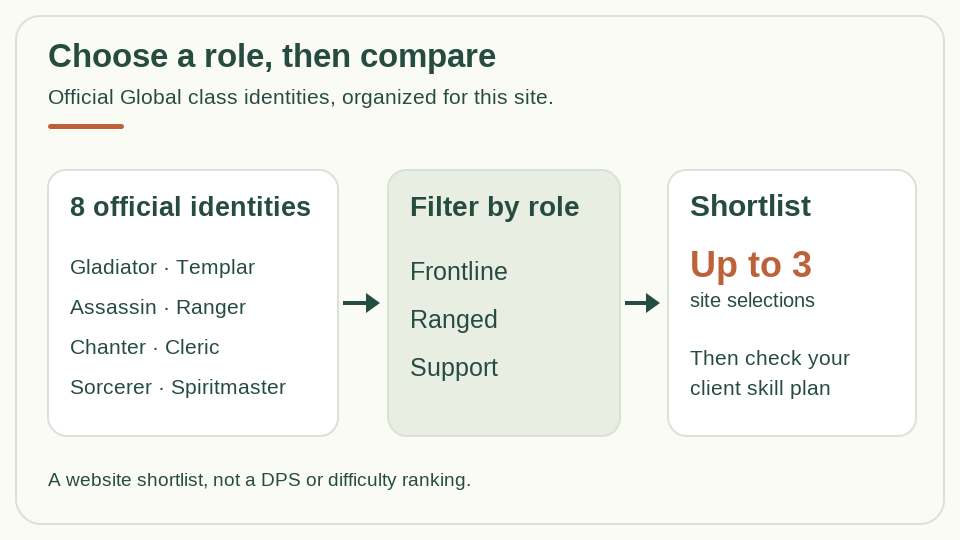
Follow the diagram from preferred responsibility to shortlist, then to a real trial and a documented plan. Return to the shortlist if the trial changes your priorities; the filter is a starting point, not a permanent verdict.
Watch the class comparison tool in use
Walkthrough transcript
- Open Preferred focus and choose protection.
- Select Templar and Chanter for the shortlist.
- Read their documented responsibilities together.
- Open the skill planning link for the class you want to investigate.